Product Description
Tabular Alumina is a pure sintered α-alumina (corundum) material fully densified by
rapid sintering without sintering aids at temperatures above 1800°C. It consists of
large, well-developed hexagonal tabular α-alumina crystals up to 200 µm in length.
Its excellent thermal volume stability, thermal shock resistance, and mechanical strength
result from its unique microstructure — low open porosity and large crystals containing
closed spherical pores formed during recrystallization in rapid sintering.
Key Features
✓Extremely high refractoriness
✓Excellent mechanical strength and abrasion resistance
✓Very high chemical purity
✓Excellent dielectric properties
✓Strong resistance to acid and alkali corrosion
Typical Applications
Steel & Foundry
Cement & Petrochemical
Ceramics & Waste Incineration
Electrical Insulators
Kiln Furniture
Catalyst Support
Epoxy / Resin Filler (ground)
Ground tabular alumina serves as a filler in epoxy/resin systems
for high dielectric strength, thermal conductivity, and abrasion resistance.
Chemical Composition (Typical, %)
| Component | All Sizes | -45 µm L1 | -45 µm STD | -20 µm |
|---|
| Al2O3 (by difference) | 99.5 | 99.5 | 99.1 | 99.3 |
| Na2O | ≤0.40 | ≤0.40 | ≤0.60 | ≤0.40 |
| SiO2 | ≤0.09 | ≤0.09 | ≤0.12 | ≤0.15 |
| Fe (Magnetic) | ≤0.02 | ≤0.02 | ≤0.30 | ≤0.02 |
"All Sizes" excludes -45 µm L1, -45 µm STD, and -20 µm.
Physical Properties
Bulk Specific Gravity
≥ 3.50 g/cm3
Particle Size Distribution — Open Sizes
| Range | DIN (mm) | Tyler (mesh) | Typical (%) | Min/Max (%) |
|---|
| 0–3 mm (-6 mesh) | +3.35 | 6 | 1 | 0–8 |
| +2.0 | 9 | 32 | — |
| +1.0 | 16 | 29 | — |
| 0–1 mm (-14 mesh) | +1.4 | 12 | 7 | 1–21 |
| +1.0 | 16 | 11 | — |
| +0.5 | 32 | 36 | — |
| 0–0.5 mm (-28 mesh) | +0.71 | 24 | 14 | 5–26 |
| +0.5 | 32 | 14 | — |
| +0.25 | 60 | 37 | — |
| 0–0.3 mm (-48 mesh) | +0.3 | 48 | 9 | 2–20 |
| +0.25 | 60 | 3 | — |
| +0.125 | 115 | 29 | — |
| -0.045 | 325 | 29 | 15–45 |
| 0–0.2 mm (-65 mesh) | +0.212 | 65 | 3 | 0–5 |
| +0.125 | 115 | 12 | — |
| +0.063 | 250 | 38 | — |
| -0.045 | 325 | 41 | 25–55 |
Fine Grades
| Grade | Description | -45 µm (%) | Min/Max (%) | Cilas d50 |
|---|
| -45 µm L1 | (-325 mesh L1) | 41 | 25–55 | — |
| -45 µm STD | (-325 mesh STD) | 99 | 95–100 | — |
| -20 µm | (-635 mesh) | 98 | 95–100 | max. 3.1 µm |
Particle Size Distribution — Closed Sizes
| Range | DIN (mm) | Tyler (mesh) | Typical (%) | Min/Max (%) |
|---|
| 3–6 mm (3–6 mesh) | +6.3 | 1/4 in | 1 | 0–4 |
| +5.0 | — | 22 | — |
| +4.0 | 5 | 40 | — |
| 2–5 mm (1/4 in–8 mesh) | +6.3 | 9 | 1 | 0–3 |
| +5.0 | — | 14 | — |
| +4.0 | 5 | 31 | — |
| 1–3 mm (6–14 mesh) | +4.0 | 9 | 2 | 0–6 |
| +3.35 | 6 | 4 | — |
| +2.0 | 9 | 52 | — |
| 1–2 mm (8–14 mesh) | +3.35 | 16 | 2 | 0–10 |
| +2.0 | 9 | 11 | — |
| +1.4 | 12 | 56 | — |
| -1.0 | 16 | 3 | 0–10 |
| 0.5–1 mm (14–28 mesh) | +1.4 | 12 | 1 | 0–2 |
| +1.0 | 16 | 19 | — |
| +0.71 | 24 | 50 | — |
| 0.2–0.6 mm (28–48 mesh) | +0.71 | 32 | 4 | 0–10 |
| +0.5 | 32 | 11 | — |
| +0.25 | 60 | 81 | — |
| -0.212 | 65 | 3 | 0–7 |
Values listed are typical averages from product data; Min/Max values are
standard specification limits. Custom particle size distributions available on request.
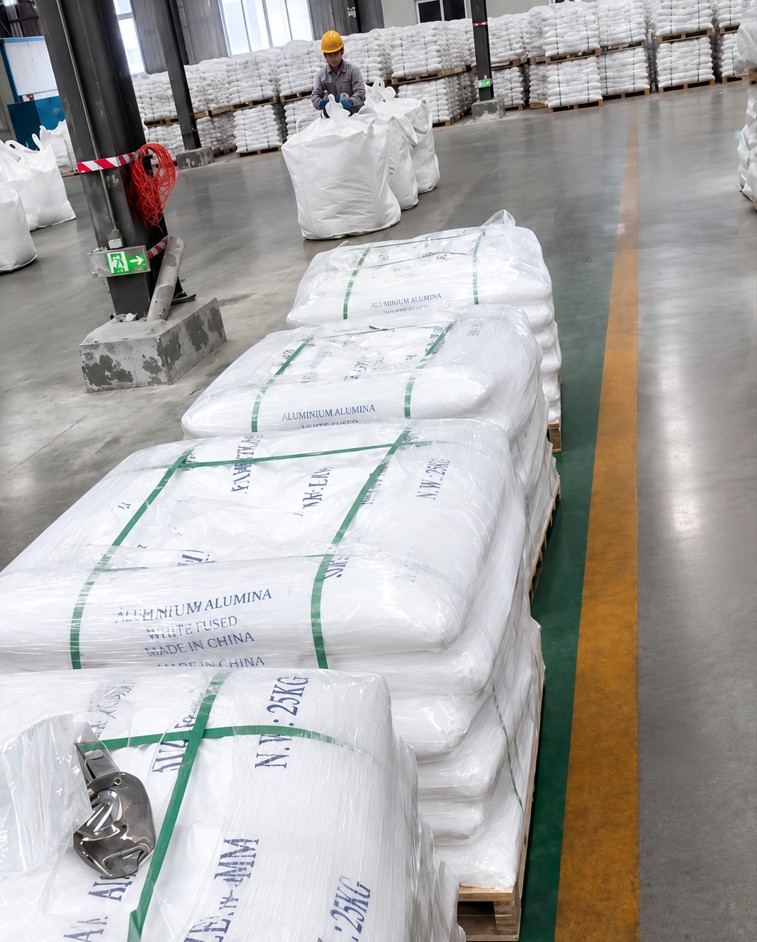
Packaging
Custom
Other sizes & packing on request